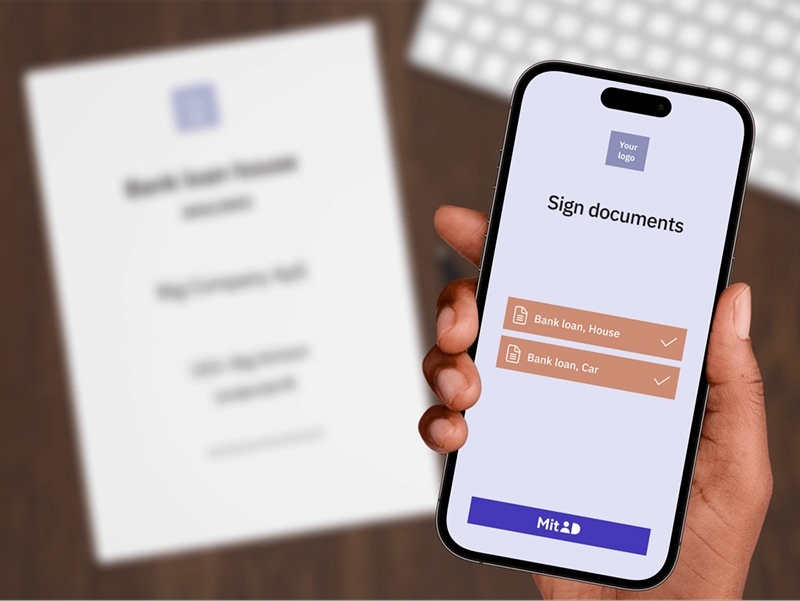
.png)
If you’re looking to add eID-based signatures to your product or service, you’ve got two primary options:
- Use a ready-to-sign platform that takes care of the entire signing flow and interface
- Design your own flow around an eID engine that handles verification behind the scenes and document signing
Both deliver legally valid eID signatures via the same national identity systems (MitID, BankID, and so on).
The major difference is strategic ownership: Who’s in charge of the user experience when someone signs a document?
The platform approach treats signatures as an external, third-party experience. The own-flow one gives you more control over the entire signing workflow.
So how do you decide which one to go with?
Let’s compare the two options, their key differences, and how to pick the one best suited for your needs.
What is a ready-to-sign platform?
It’s exactly what it sounds like: a complete end-to-end signing service.
The provider handles the entire signing flow, the backend infrastructure, and the user interface.
In this scenario, when it’s time to sign, you hand the user off to the provider’s environment.
What that means in practice:
- You integrate with the platform’s API, but users are redirected to the platform’s signing page to complete the process.
- Your branding is typically limited to logos and color adjustments. (Full white-label solutions may be offered at higher price tiers or as an add-on.)
- You can often connect seamlessly to CRMs, HR systems, and document management tools via the third-party platform.
- Document workflows and signature data are managed and stored by the signature solution provider.
- Time to market is fast: Often days with minimal internal development or technical expertise.
This model works great for organizations that need a reliable signature functionality fast, without having to incorporate it into their own product.
It is best when signing is a supporting function, like HR departments processing employment contracts or procurement teams managing vendor agreements.
What is the “Design your own flow” option?
This approach treats eID signatures as embeddable components within your own products.
You connect to a signature engine via API, but build your own experience layer on top of it. As such, your users never leave your application: Signing feels like a native part of your product.
What this means in practice:
- Your users stay inside your digital environment throughout the entire signing journey.
- Verification happens behind the scenes via relevant national eIDs.
- You get to decide how the signing flow looks, behaves, and integrates with your processes.
- You control what data you store and how signing fits into your architecture.
- Signatures become an integral part of your product instead of a separate tool.
This model is best for companies that see signing as a core part of their product instead of an operational task to outsource.
Think software companies embedding signatures into a customer-facing solution or organizations in sensitive industries like government or finance who want to own the environment to reduce friction and privacy concerns.
A quick way to decide…
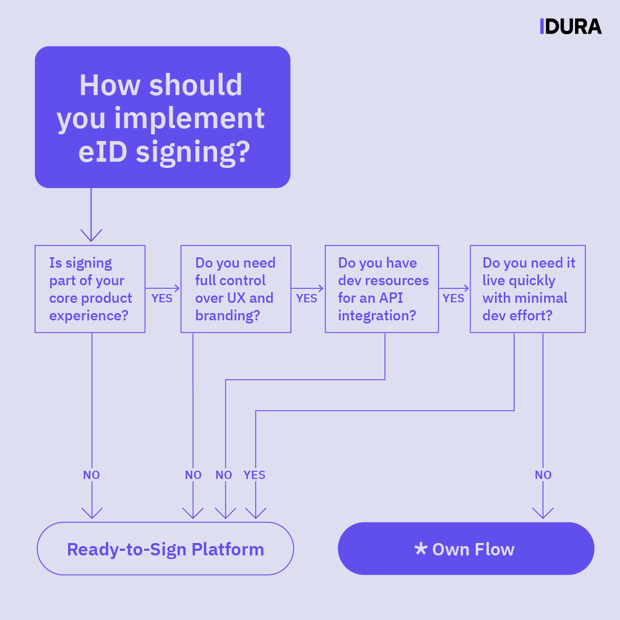
Here’s a simple rule-of-thumb guide to help you pick the right option.
Choose a signing platform if:
- You want to be up and running quickly with minimal effort.
- Signatures are a supporting function rather than a business differentiator.
- You don’t mind handing users off to the third-party platform’s UX, branding, and workflow.
- You cannot allocate internal resources to implementing eID signature flows.
Choose your own flow if:
- Signing is an integral part of your product or service offering.
- You need full control over branding and user experience.
- You want signing to feel truly native without jarring redirects.
- Long-term ownership matters more than speed to market.
How do the two options stack up?
Here’s a side-by-side comparison to help you make an informed decision:
|
Your own signing flow |
Ready-to-sign platform |
|
|
Strategic positioning |
Signing is a core capability of your product |
Signing is an operational or supplementary process |
|
UX ownership |
Full ownership of UX, branding, flow logic, and communication |
Partial control, mainly managed by the third-party platform |
|
White label |
Typically fully white-label: domain, styling, and per-customer branding |
Often limited to logo and colors, the white-label option is either restricted or an add-on |
|
Business differentiation |
Signing is a competitive differentiator |
Signing is a standardized, off-the-shelf process |
|
Roadmap ownership |
You decide when and how signing evolves |
Roadmap depends on third-party platform priorities and release cycles |
|
Signing flow |
Fully customizable, tailored to your business logic |
Constrained by platform templates and configuration limits |
|
Multi-tenant use |
Easy to offer signing as a core feature to business customers |
More complicated: tenant-level branding may be limited or cost extra |
|
Time to market |
Moderate. Requires integration and product ownership |
Fast. Ready-made workflows and UI |
|
Internal resource requirements |
Requires product ownership and technical expertise |
Minimal effort beyond initial integration |
|
Operational ownership |
You design the signing journey; engine handles validation |
Platform handles workflow and signing orchestration |
|
Best for |
SaaS companies with signing embedded into their core product |
Businesses that need document signing without developing internal capabilities |
A practical decision checklist
This is rarely a purely technical question. The decision often comes down to:
- Who owns the user experience at the moment of commitment
- How much control you have over branding and flows
- Your long-term product differentiation
- Your dependency on a third-party roadmap
Here’s a handy checklist you can use to help steer the conversation in your own company:
1. Brand & user experience
- Do we want full control over the signing experience?
- Is it important to make users feel like they never left our product or service?
- Do we need per-customer or per-tenant branding?
More “yes” = build your own flow
More “no” = pick a ready-to-sign platform
2. Product strategy
- Is signing a big part of our value proposition?
- Do we want signing to be a competitive differentiator?
- Will we offer signing as a feature to clients or customers?
More “yes” = build your own flow
More “no” = pick a ready-to-sign platform
3. Architecture & ownership
- Do we need architectural control over signing processes?
- Do we want to avoid depending on an external roadmap?
More “yes” = build your own flow
More “no” = pick a ready-to-sign platform
4. Resources & timing
- Do we have the resources and expertise to properly embed signing?
- Can we afford to wait to launch the signing flow?
- Do we value strategic flexibility over speed to market?
More “yes” = build your own flow
More “no” = pick a ready-to-sign platform
Why not a hybrid approach?
In the real world, decisions are rarely so black-and-white.
You might have multiple departments in your organization, each with its own needs when it comes to eID signatures. Or you might be under pressure to launch quickly while planning to work toward an own-flow solution further down the line.
In some cases, you might want to pick a middle-ground approach:
- Design a white-label customer-facing flow using an embedded eID signature engine while leaning on off-the-shelf platforms for internal signing needs.
- Launch with a ready-to-sign platform while gradually developing your own flow to replace it later.
- Pick a predictable per-user pricing model to start with, but be ready to switch gears if your business scales.
- …and so on
It doesn’t always have to be an either-or decision, as long as you’re intentional about it. Identify which parts of your business need speed and convenience vs. those where you require more control.
Then mix and match accordingly.
So…what should you pick?
As you can see, the decision ultimately comes down to the role signatures play in your business, now and in the future.
Ready-to-sign platforms are ideal when you need a simple and quick way to launch a signature solution with a minimum of effort. They work reliably and can easily address your internal needs for signing documents.
Own signing flows are best when you need to incorporate signing into your core product. While they often require more involvement and ownership from your side, they grant you far greater control and strategic flexibility while also serving as a competitive differentiator.
You should now know exactly where each option fits in your own business.
Stay in control of your signing flow with Idura
Idura’s eID signatures make it easy to design your own signing flow.
We take care of the engine and leave the branding in your hands.
Let your users sign without ever leaving your product experience.