How to Add White-Label eID Signatures to Your Own Product
By Daniel Gniazdo on 16 March 2026
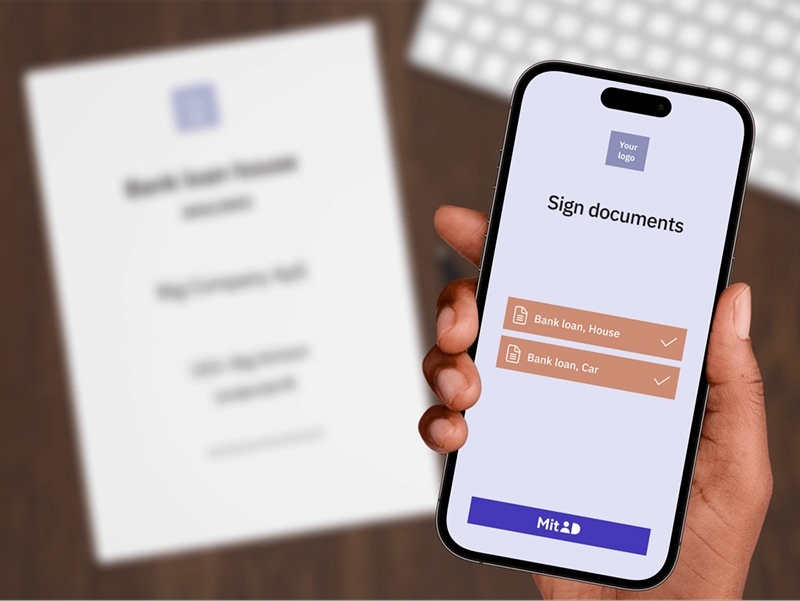
Digital companies and products often reach a stage where they need to start collecting legally binding signatures.
When that moment comes, the path of least resistance is to pick a third-party platform.
But while it’s quick and easy to set up, this sends users outside your product or website.
Let’s look at the benefits of designing your own eID signature flow and the way to do it.
1. When do you actually need eID signing?
Identity-verified signatures are most relevant when you require high levels of trust or regulatory compliance. Often both.
Typical industries and use cases include:
- Financial services: Documents where verified identities are a regulatory requirement (pension agreements, loan applications, account registrations, etc.).
- Insurance: Policy applications and claims processing, which must be traceable and legally binding.
- Government & public services: Permit applications, benefits claims, citizen-facing online forms, etc.
- Legal & accounting: Power-of-attorney documents, client contracts, audit forms, etc.
- Healthcare: Patient consent forms, treatment agreements, etc.
- Real estate: Mortgage documents, sales contracts, rental agreements, etc.
- HR: Employee contracts or non-disclosure agreements.
- Car dealerships: Sales agreements or leasing contracts.
- Delivery services: Proof of delivery and receipt confirmation.
In short, eID signatures should be part of any regulated or high-trust signing flow.
If your company falls into one of these categories, the question isn’t whether you need eID signatures, but how to implement them.
2. How can you implement eID signatures?
If you want to set up eID signing in your company, there are three main options:
- Build in-house: You can connect directly to each national eID provider. While this gives you full control of the process, it’s complex and time-consuming. Each country’s eID has its own specifications, regulatory requirements, and technical integrations. You’ll also have to juggle multiple providers if you operate in different countries.
- Use a third-party platform: You can outsource the signing flow to a ready-made signature portal. This gets you up and running fast, but it sends your users into the platform’s environment to complete the signing. You have no control over branding and user experience, and you’re at the mercy of the provider for any future features or improvements.
- Pick a white-label solution: You can also integrate the eID signatures into your own flow via API. This way, signature verification happens behind the scenes, while your users stay in your product the entire time. This gives you the best of both worlds: Control over the user experience without having to build your own signature engine from scratch.
For a deeper comparison of the two approaches, see: “Ready-To-Sign Platform vs. Your Own eID Signature Flow: How to Choose the Right Approach?”
3. Why build your own eID signature flow?
Here’s why building your own signing flow via API is often the preferred option:
1. You own the branding
With a white-label solution, the signing flow looks and feels like the rest of your product.
You get to apply your logo, brand colors, and visual identity to every step. Users won’t see “Powered by [Provider]” messaging or run into an unfamiliar interface that differs from your platform.
All of this strengthens your brand in your customers’ eyes.
2. You design the signing experience
With a third-party platform, you’re usually limited to whatever UX templates are available.
But when you build a white-label signing flow, you stay in control of every step.
You decide what the users see, how and when they see it, and the exact signing process. If you want to add a document preview before signing or adjust the flow for different customer types, you can.
3. You own the feature roadmap
If you ever need to change or extend the signature flow, the API approach makes this easy.
Instead of depending on the signature provider’s product roadmap, you get to iterate on the signing flow directly.
You can A/B test different approaches and adjust the signing process based on your customers’ requirements. This way, you can gradually optimize the signing flow to increase completion rates.
In the end, signing becomes an integral part of your product and value proposition instead of an external dependency.
4. You reduce unnecessary friction
Whenever you send a customer to an external portal, you inevitably introduce friction.
They leave your website and enter a new environment, just when they’re about to complete the often critical signature step of their journey.
This friction can have real consequences, from reduced trust to customers dropping off altogether.
A native signature flow helps you reduce this friction and provide a consistent user journey. Users get to complete the entire process without ever leaving your platform.
All of this consistency matters, from branding to product roadmap, especially in industries where trust is a factor.
4. How can you embed eID signatures into your product?
If you want to design your own signing flow without having to build the infrastructure yourself, you can turn to a signature provider like Idura.
Idura Signatures is designed as a white-label solution.
In simple terms: Idura provides the eID signature engine. You provide the user experience.
The way it works is straightforward:
- Test for free: Set up your free Idura test account to explore our integrations in a sandbox environment. This lets your team test the entire flow at no cost.
- Design your flow: Pick your own colors and branding elements and customize the journey to match your product.
- Connect to eIDs: Select your mix of eIDs, depending on your markets and needs. We support all major Nordic and European eIDs through a single integration.
- Upgrade when ready: Once you’re happy with your test setup, upgrading is easy: Simply pick a subscription option that best fits your business, and switch from test to production.
5. Key takeaways and next steps
Industries that rely on legally binding signatures need more than a simple signature checkbox. They need identity-verified signatures backed by national eIDs.
Your business can choose to build this in-house, outsource signatures to a third-party provider, or design a white-label signing flow via API.
Each option entails trade-offs when it comes to speed-to-market, level of ownership, and customer experience. The white-label path is a middleground that strikes a balance between process ownership and ease of deployment.
Idura Signatures provides you with the signature engine while leaving you in charge of your product and branding.
To try it for yourself, create your free account and start testing in a few clicks.
If you want a better understanding of how Idura Signatures work, check out our documentation.

What Are the Differences Between SES, AES, QES, and Sealing?
.png)
Ready-To-Sign Platform vs. Your Own eID Signature Flow: How to Choose the Right Approach?