Caller Authentication vs. Voice Biometrics
By Daniel Gniazdo on 30 March 2026

Voice biometrics is one of the most convenient and technically advanced ways to verify someone’s identity.
Instead of asking callers to remember old PINs or hunt for one-time passwords, voice biometrics just needs to hear how they sound.
Unfortunately, while otherwise robust, voice biometrics is facing a new and growing challenge in the form of AI voice cloning and deepfake scams.
Let’s look at how voice biometrics compares to eID-based caller authentication.
How voice biometrics works
Voice biometrics lets systems identify a caller by analyzing their voice characteristics: pitch, tone, cadence, and so on.
To make this happen, the system first creates and stores a unique “voiceprint” for each customer.
When that customer calls in, their speech is checked against the voiceprint to confirm their identity.
In practice, this can happen in two different ways:
- Active voice biometrics: The caller is asked to speak a predefined phrase that must match the stored sample.
- Passive voice biometrics: The system silently listens to the caller’s voice patterns in real time and flags any mismatch to the call center agent.
The process is fast, with almost no added friction. As a result, voice biometrics tends to reduce call handling time by up to 45 seconds.
For the caller, the experience feels truly effortless, especially with passive verification.
How eID caller authentication works
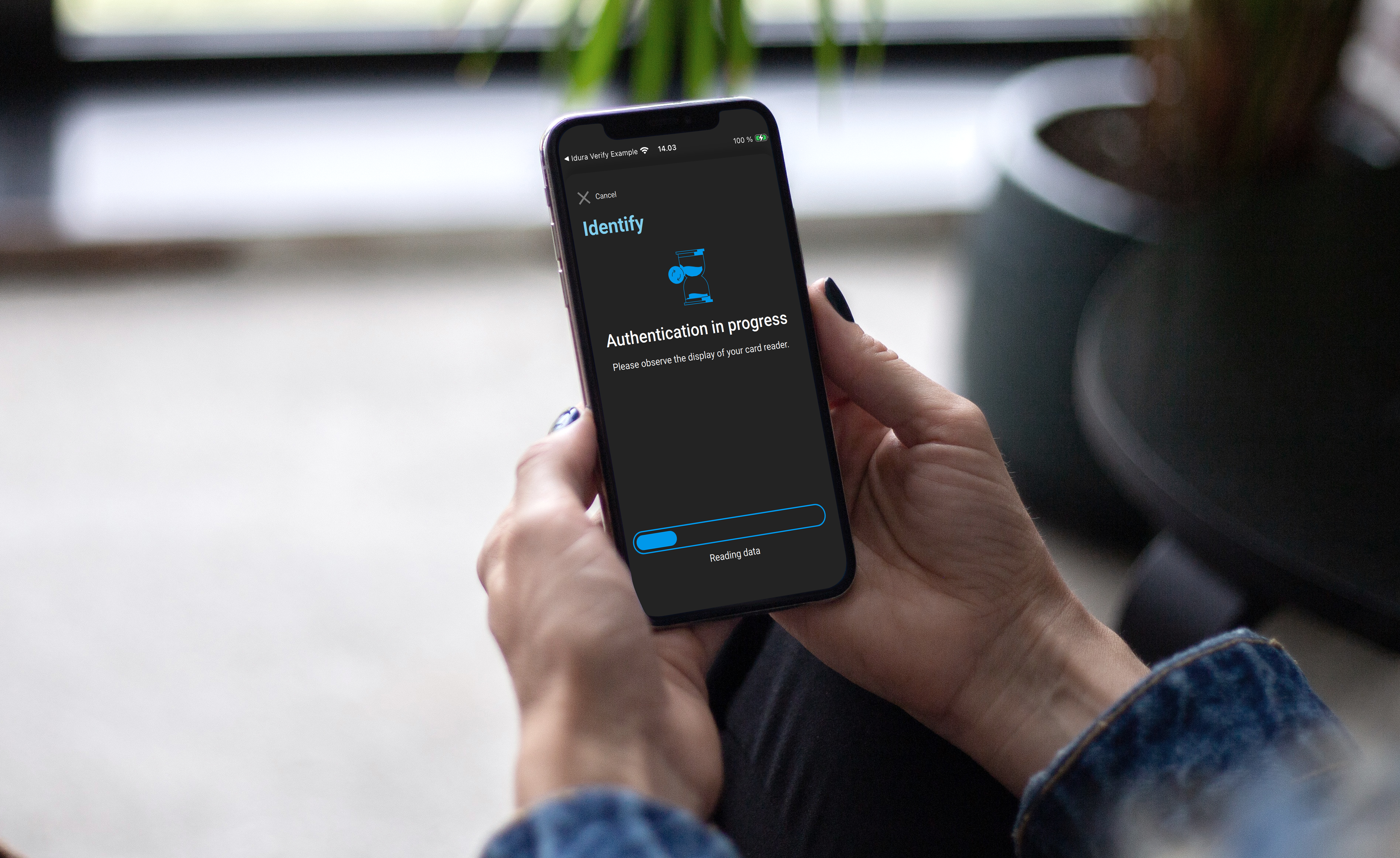
eID-based caller authentication relies on national eID apps that most citizens already use.
Here’s how the process looks:
- The agent triggers the authentication request.
- The caller receives the request in their eID app and verifies on their device.
- The agent sees the verified status, and the call continues.
It’s familiar, straightforward, and robust.
For a more comprehensive look, read: “How Exactly Does Caller Authentication Work?”
Caller authentication vs. voice biometrics: side-by-side
Here’s how caller authentication compares to voice biometrics as a verification method:
When does voice biometrics make sense?
Unlike increasingly outdated traditional methods, voice biometrics is modern, secure, and leaves a clear audit trail.
It’s also great for customer experience: Callers are verified instantly, with little to no additional effort on their part.
Unfortunately, voice biometrics is susceptible to the growing threat of AI deepfakes and biometric spoofing. AI-driven fraud jumped by 1,210% in 2025.
To counter these threats, providers of voice biometrics apply increasingly sophisticated anti-fraud measures. But these efforts are struggling to keep up, turning the fight against deepfakes into a game of whack-a-mole.
Voice biometrics may also be less reliable in noisy environments or on poor-quality phone lines.
Despite these issues, voice biometrics remains a solid choice for many contact centers. The market for voice biometrics is projected to grow from $2.87 billion in 2025 to 22.76 billion in 2034 in the US alone.
But if you operate in an industry where AI deepfakes and spoofing are a real problem, you may have to look for a more fraud-resistant way to verify someone’s identity.
The next step
Voice biometrics relies on a physical trait that, until recently, was hard to fake. Namely, the way someone sounds. But AI has changed the equation, sparking a race to combat the threat of deepfakes that shows no sign of winding down.
In contrast, eID-based caller authentication uses cryptographic verification via a national ID and a familiar app on a customer’s device. Instead of relying on the customer’s voice, caller authentication verifies their identity through a process designed for that exact purpose.
Also, unlike voice biometrics, eID caller authentication isn’t limited to verifying existing customers, since it doesn’t depend on stored voiceprints or customer records. You can use it to onboard new customers.
For any company that finds voice biometrics insufficient or unreliable, eID provides an alternative that sidesteps most of its flaws.
Ready to make your service calls safer and simpler?
Caller authentication is already available with Norwegian and Swedish BankID, with the Danish MitID coming soon.
Start testing for free today or contact our sales team to learn more.

-2.png)